Fast Retail Store Visualization with AI
In today’s fast-paced retail landscape, staying ahead of consumer trends and delivering exceptional shopping experiences are critical to success. Retailers are increasingly turning to Artificial Intelligence (AI) to transform their operations, particularly in the realm of store visualization. By leveraging AI technologies, retailers can visualize, design, and optimize their store layouts faster and more effectively than ever before.
Introducing ReRoom AI
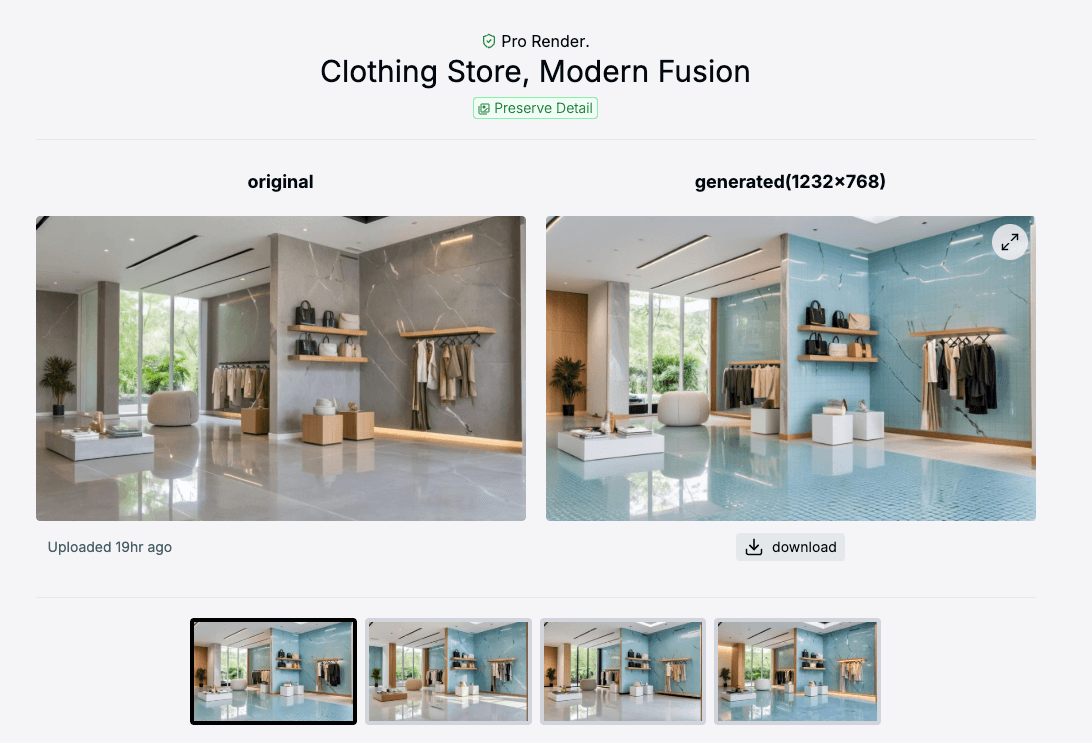
ReRoom AI integrates seamlessly into the design workflow. Transform your space! Upload a picture of your room, explore over 20 distinct design styles, and receive photorealistic visualizations within seconds. Whether it’s experimenting with store layouts or visualizing different aesthetic concepts, ReRoom AI significantly reduces the time and effort required for rendering tasks. By enabling rapid iteration and providing realistic visualizations, ReRoom AI helps stakeholders make informed decisions with ease.
Key Benefits of AI in Store Visualization
1. Accelerated Design Process
AI-powered tools, including ReRoom AI, can generate store layouts and renderings in minutes by analyzing factors such as product categories, customer traffic patterns, and sales data. This allows retailers to iterate on designs rapidly, ensuring the final layout is both functional and appealing.
2. Enhanced Customer Experience
With AI, retailers can simulate customer journeys and identify bottlenecks or underutilized spaces. This insight enables them to optimize product placement and navigation, creating a seamless and enjoyable shopping experience.
3. Cost Efficiency
By using AI tools like ReRoom AI to test and refine layouts virtually, retailers can significantly reduce the costs associated with physical prototyping and trial-and-error adjustments.
4. Personalization at Scale
AI tools can tailor store layouts to specific customer demographics or regional preferences. For example, a grocery store in an urban area might prioritize grab-and-go sections, while a suburban store could focus on expansive aisles for family shopping.
Real-World Applications
Several retailers have already embraced AI for store visualization. For instance, fashion retailers use AI to create dynamic displays that adjust based on inventory levels and seasonal trends. Grocery chains employ AI to optimize aisle layouts, ensuring high-demand products are easily accessible during peak hours. Tools like ReRoom AI take this a step further by enabling real-time rendering of these layouts, making it easier to visualize the impact of changes before implementation.
Challenges and Considerations
While the benefits of AI in store visualization are clear, there are challenges to consider. Integrating AI tools with existing systems and ensuring data accuracy require careful planning. Additionally, retailers must balance automation with human creativity to maintain the unique character and branding of their stores.
The Future of Retail Visualization
As AI technologies continue to evolve, the possibilities for retail visualization are virtually limitless. Emerging innovations, such as augmented reality (AR) and 3D modeling, will further enhance the ability to create immersive and interactive store designs. Tools like ReRoom AI will likely play a pivotal role in this evolution, empowering designers to bring their visions to life with unprecedented speed and ease.
In conclusion, AI is not just a tool for speeding up retail store visualization—it’s a transformative force that empowers retailers to innovate and excel. By embracing AI-driven visualization solutions like ReRoom AI, retailers can create environments that delight customers, drive sales, and adapt to an ever-changing market landscape.